NEVADA TEST SITE
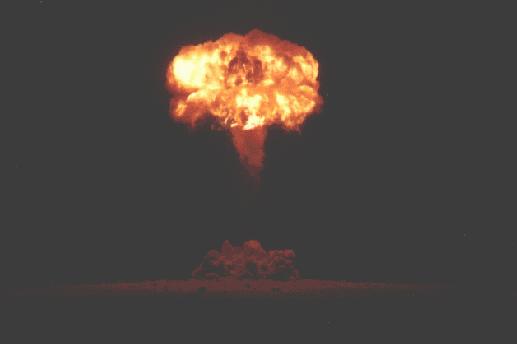
An experimental device designed by Los Alamos Scientific Laboratory, code-named Newton, was detonated at 5:30 a.m. today at 1500 feet above Yucca Flat firing area. It was suspended beneath a 75 foot balloon.
This was the 20th full-scale detonation of the Summer 1957 series. It was the 12th and final full-scale Los Alamos test in Plumbbob, including in this category the two tests held primarily for military effects studies which utilized Los Alamos devices. Many of the Los Alamos scientific and technical personnel will be returning to their home laboratories in the next few days.
It was additionally the last of 12 shots in the series which were open to outside observation and reporting by U.S. and foreign news correspondents and to observation by civil defense personnel.
There were 23 experiments on the sequence timer. Twenty-seven airplanes and three helicopters flew technical and support missions. There was only limited Desert Rock and civil effects participation.
A rather colorful fireball resulted from the detonation. As it rose the resulting smoke ring shape was clearly visible to on-site observers, instead of being obsured by the ground dust which is drawn into the top portion of clouds on lower altitude detonation.
The main cloud rose until it extended from 19,000 feet to above 33,000 feet, according to early reports from cloud tracking aircraft and was being blown generally into the northeast at about 60 miles per hour. There should be only very light fallout along the cloud path across the NTS region. The stem segment was below 17,000 feet and should contain very little radioactivity.
The burst was heard by on site observers more as a whoosh than as a bang. There was a pronounced bang followed by rumbles at Inyokern and a somewhat lesser bang at Bishop. It was heard as a light rumble at Hiko.
